Carbide parts · ground, not moulded

The part that has to outlast the tool around it.

Carbide earns its price in the parts nobody sees: the punch behind a stamped panel, the nozzle that holds a bead for a million cycles, the seal face that runs against abrasive slurry. The catalogue shapes are cheap and everywhere. The reason to talk to a shop is the non-standard one — where the geometry, the cobalt content and the edge preparation decide whether it lasts a month or five years.
Send a drawing Grade and cobalt content
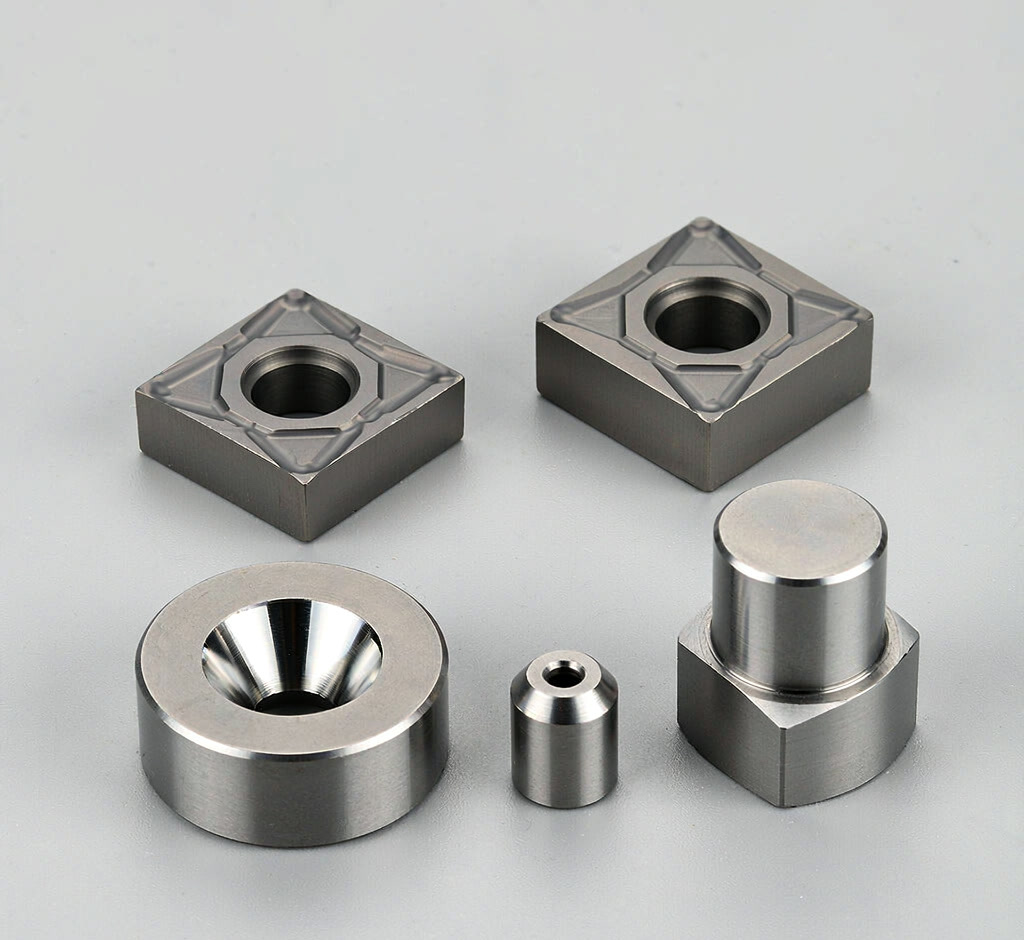
Tungsten carbide insert, punch, die and seal ring

Cobalt content is the real specification.

"Tungsten carbide" describes a family, not a material. The cobalt binder percentage decides the trade you are making, and two shops quoting "WC" at different cobalt levels are not quoting the same part.

CobaltHardnessBehaviourWhere it belongs
6–8%HighestWear-resistant, brittle under shockNozzles, seal faces, light finishing punches
10–15%MiddleThe usual compromiseGeneral punches, dies, form tools
18–25%LowerTough, deforms before it breaksImpact work, coarse blanking, rolls
TiC-steelLower than WCMachinable, weldable, cheaperLarge form tools where WC is impractical

Ranges above are the standard trade-off in the WC-Co system, not a specification of the stock on our shelf. On the quote the grade is named with its cobalt figure, because "carbide" alone tells you nothing about which of these four you are buying.

What is made here, and what is bought in.

01 / Here

Grinding, EDM, lapping

Diamond grinding to size, wire and sinker EDM for profiles that cannot be ground, lapping on seal faces, edge preparation and chamfering. ±0.02 mm on ground features as the site standard, tighter on a named feature where the drawing asks.

02 / Bought in

The blank, and any coating

Sintered blanks come from carbide plants; PVD and CVD coatings run at a coating shop. Both are named on the quote as their own line. This shop does not press powder and does not run a coating chamber.

03 / Measured

Dimensions and edges

Critical dimensions recorded per part, edge condition checked under magnification, and the reading log shipped with the batch. Hardness is the blank maker's certificate, not our claim.

Five failure modes, and what the drawing should say.

Almost every carbide part that fails early fails for one of these reasons, and four of the five are decided before the part is cut.

Edge chipping on a sharp corner

Carbide does not deform, it breaks. A dead-sharp internal corner is a crack starter. Specify a 0.2–0.5 mm radius or a chamfer; if the drawing shows a sharp corner, we will ask before making it.

Cobalt leaching in a wet environment

Water-based coolant, food contact or mild acids attack the cobalt binder and leave a porous surface that wears fast. Grade choice and passivation matter more than hardness here — tell us the medium, not just the load.

EDM recast layer left on a wear face

Wire or sinker EDM leaves a thin, brittle recast layer. On a sliding or sealing face it spalls and takes the tolerance with it. The fix is a ground or lapped finish after EDM, which is a separate line on the quote.

Grade chosen for hardness alone

The hardest grade available is the wrong answer for anything that sees impact. If the part is a punch, tell us the material it hits and the stroke rate — that decides cobalt content more than a hardness number does.

No flatness callout on a seal face

A seal ring with a good Ra and a bad flat reading leaks. Flatness and parallelism belong on the drawing next to the roughness; without them, "lapped" means nothing checkable.

Shipping codes assumed, not checked

Carbide parts do not all fall under one tariff line. We put the description and the material on the commercial invoice; the tariff classification and the declaration are your forwarder's job, not ours to guess at.

What to send.

  • The drawing — with the critical faces marked, not just dimensioned.
  • What it hits, or what runs against it — this decides the grade more than hardness does.
  • Quantity — first article plus batch.
  • Any coating — or say "uncoated" so we do not add a line you did not ask for.
  • If it replaces a part that failed — send the failure mode. It changes the quote.
Accepted files: STEP, IGES, DXF, STL, or a PDF drawing.

What comes back: grade with its cobalt figure, grinding and EDM as separate lines, the tolerance we will hold per feature, and a ship date with its start point.

A non-standard carbide part is the normal order here.

Catalogue shapes are cheaper somewhere else. The reason to send this drawing to a shop is that the geometry is awkward, the batch is small, and someone has to say honestly whether it can be ground at all.

Send a drawing for review
Or email 4220015@gmail.com — two working days for a reply.